
Indian Trail Criminal History Checks
No single office holds every Indian Trail criminal record. The source depends on which event must be verified. The Union County Sheriff’s Office creates deputy reports and arrest records. The county detention system creates booking and custody data. The Clerk of Superior Court maintains the criminal case, while the North Carolina State Bureau of Investigation holds fingerprint-supported state history available to a person through Right to Review.
- Start with the Union County Sheriff’s Police-to-Citizen channel for a deputy-created incident or arrest event.
- Ask UCSO for the public report portion when the online result lacks the facts needed.
- Check the Union County inmate channel for present custody or a current booking.
- Search the North Carolina eCourts Portal, then obtain the official case file or certified result from the Union County Clerk.
- For your own fingerprint-supported statewide record, use the NCSBI Right to Review process.
These sources can describe related events without matching line for line. An arrest allegation can change before filing, and a current jail result cannot show a final court outcome. The broader Union County arrest search explains the county booking channels in more depth.
Indian Trail Sheriff Contract Records
Indian Trail has no municipal police department. The town contracts with the Union County Sheriff’s Office for enhanced local coverage, and the official town page describes 38 full-time employees assigned through that model. Deputies serve Indian Trail, but the reports remain Sheriff records. That distinction controls where an incident copy, arrest report, or law-enforcement question goes.
The official Indian Trail Sheriff bureau page is shown here with local office context.
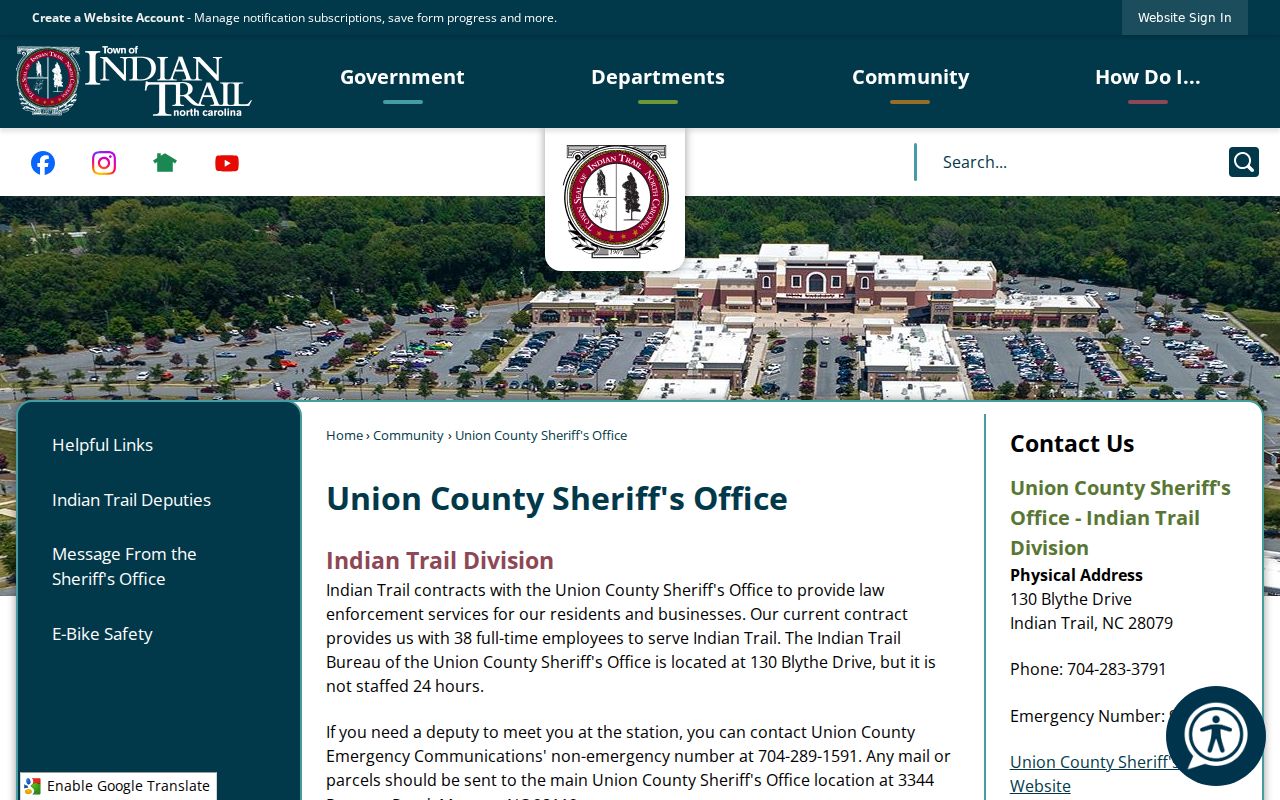
The local bureau gives Indian Trail residents a nearby point of contact while UCSO remains the law-enforcement record custodian.
The town’s May 27, 2025 agenda materials authorized negotiation of a renewed Sheriff agreement for the next fiscal year. That milestone reinforces the same practical route: Indian Trail public-safety records are county Sheriff records, not files of a town police agency.
Records at the Indian Trail Police Department
The approved heading names the police-department concept, but Indian Trail does not operate such a department. The functional local office is the UCSO Indian Trail bureau at 130 Blythe Drive, Indian Trail, NC 28079. Its phone number is 704-283-3791. The bureau is not staffed around the clock, so a visitor should call before going there.
To request a deputy, call Union County Emergency Communications at 704-289-1591. Mail for Sheriff records goes to UCSO at 3344 Presson Road, Monroe, NC 28112. P2C can surface some Sheriff arrests and incidents online, but an absent result is not final. Protected details, timing, spelling, jurisdiction, or the type of event may explain the gap.
UCSO Indian Trail Bureau
130 Blythe Drive
Indian Trail, NC 28079
704-283-3791
Call before visiting; use 704-289-1591 to request a deputy.
C-COM dispatch serves the Sheriff and all five municipal police departments in Union County. That shared dispatch role does not change records custody. C-COM is the right source for its own 911 audio or computer-aided dispatch data, while UCSO remains the source for an Indian Trail deputy’s incident or arrest report.
Indian Trail Record Custodian Test
The most common Indian Trail records mistake is sending a Sheriff request to Town Hall. The Town Clerk keeps records made or received in town business, such as meeting material, contracts, budgets, permits, and town correspondence. UCSO keeps deputy reports, arrest records, and other records created through law enforcement activity. Booking records then belong to the Sheriff’s detention operation, and case files belong to the court clerk.
| Indian Trail Record | Correct Custodian | Starting Channel |
|---|---|---|
| Town contract, agenda, or administrative file | Indian Trail Town Clerk | Town Public Records Request Form |
| Deputy incident or arrest report | Union County Sheriff’s Office | UCSO P2C or Sheriff request |
| Current booking or custody | UCSO detention operation | Inmate Inquiry or jail phone |
| Filed charge, hearing, or disposition | Union County Clerk of Superior Court | eCourts discovery, Clerk for official file |
This test prevents delay and also clarifies what each result proves. A town contract documents public administration. A deputy report states what officers recorded. A booking result shows custody. Only the court file establishes what prosecutors filed and how the court resolved it.
Booking and Arrest Records in Indian Trail
Indian Trail has no town jail. A custodial arrest by an assigned deputy is processed through the Union County Sheriff’s detention system at 3344 Presson Road in Monroe. The arrest or incident event may appear through UCSO Police-to-Citizen, and present custody may appear in Inmate Inquiry. The jail-information line is 704-292-2600; UCSO’s main line is 704-283-3789.
A missing inmate result can mean release or transfer, not that no Indian Trail arrest occurred. The current roster is not a full booking archive. Compare the arrest date, booking agency, primary charge, and any incident number, then check the filed case. Court charges can be amended, dismissed, or never filed, so a booking allegation should never be described as a conviction.
Note: Indian Trail arrest records, county booking data, and court dispositions are separate records with different update times and custodians.
Indian Trail Crime Map Records
The town’s Sheriff page routes residents to the Union County Community Crime Map. Searchers can narrow Indian Trail incidents by date, incident type, and address. This view helps identify report geography and patterns, but it is not a criminal case docket. A map point reflects an agency record associated with a place; it does not show that a person was convicted.
Protected categories can be omitted, and map systems can lag or place an address imperfectly. Treat “no pin” as inconclusive. When a known Indian Trail event is missing, gather the date, location, and report number if available, then contact UCSO. If the question concerns the result of charges, move to the North Carolina eCourts Portal or the Clerk rather than trying to infer an outcome from a map.
The Indian Trail Municipal Court File
There is no Indian Trail municipal criminal court and therefore no town court file to request. North Carolina’s unified General Court of Justice routes local traffic and misdemeanor matters to District Court in Union County. Felony charges begin with District Court proceedings and qualifying trials proceed in Superior Court. The Union County Clerk of Superior Court maintains both sets of local court records.
| Court Name | North Carolina District Court and Superior Court in Union County, not an Indian Trail municipal court. |
|---|---|
| Case Types | District Court handles traffic matters, misdemeanors, and early felony proceedings; Superior Court hears felony trials. |
| Lookup Channel | North Carolina eCourts Portal for public discovery; courthouse terminals and the Clerk for official records. |
| Docket Contents | Case number, parties, charge, status, events, hearings, disposition, judgment, and public documents when enabled. |
| Official Copies | Ask the Union County Clerk; a certified single-county search uses AOC-CR-314 and costs $25. |
The Judicial Branch’s Union County page provides the local court route. Portal information is useful but is not the official court record. The full Union County case lookup details search fields and Clerk fallbacks.
Indian Trail Town Record Requests
The Indian Trail Public Records Request page directs administrative requests to a web form routed to the Communications Director. The Town Clerk is custodian of records in town custody and control under Chapter 132. Any person may request them. The town says requesters receive a response within ten days, while a large request can take longer.
The official Indian Trail request instructions are shown here with the town’s process and cost statement.
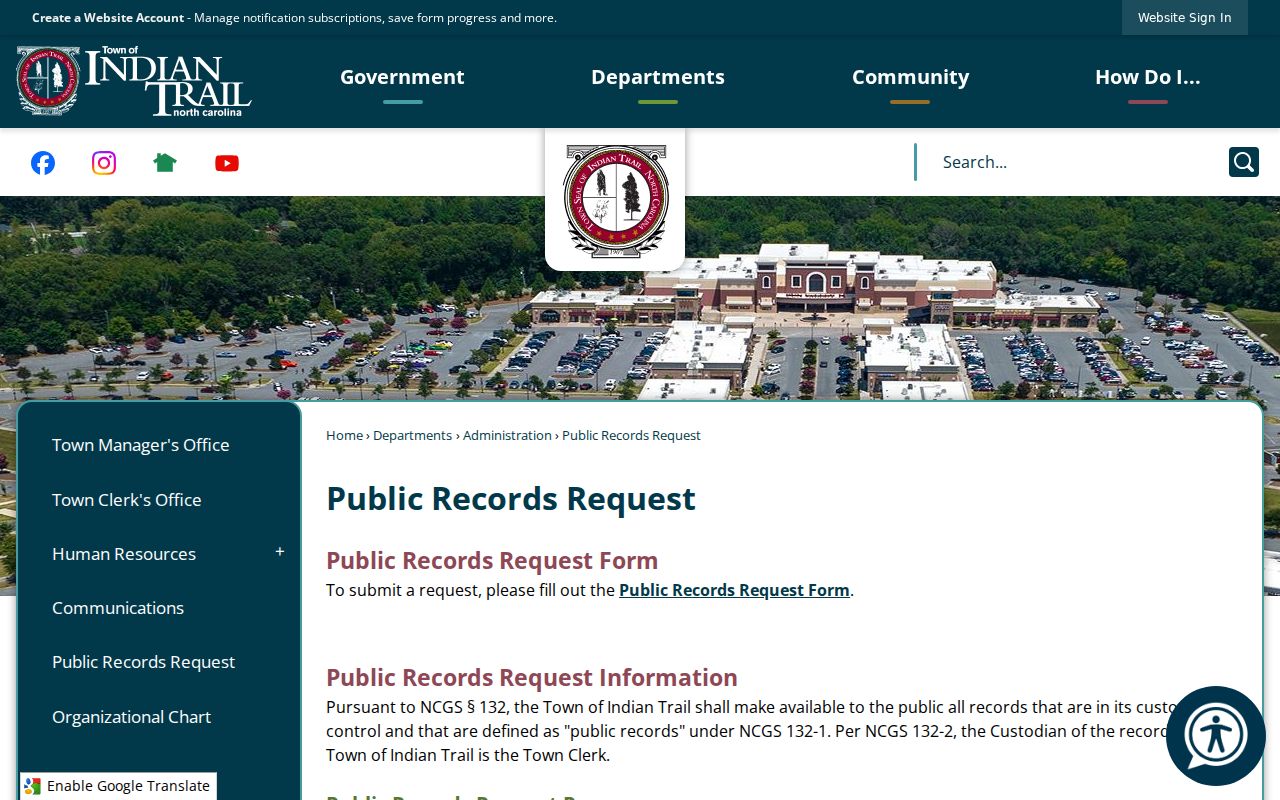
The page is the right route for town files but clearly does not turn Town Hall into the custodian of Sheriff reports.
Most town records are delivered electronically at no cost. More than four hours of clerical or information-technology help can trigger a special service charge under G.S. 132-6.2(b). The interactive form fields were not fully visible in the research, so requesters should follow the live form rather than rely on an invented field list.
How Indian Trail Records Reach the County
An assigned deputy creates the incident or arrest report. If the person is taken into custody, the Sheriff’s detention staff create the booking record and collect fingerprints when required. Prosecutors decide what charges to file. The Union County Clerk then maintains the District or Superior Court case, and eligible fingerprint-supported arrest and disposition data may flow to the North Carolina State Bureau of Investigation.
Record flow: UCSO Indian Trail bureau › Union County detention and courts › North Carolina State Bureau of Investigation
Each stop answers a different question. P2C is strongest for a recent Sheriff event. Inmate Inquiry addresses current county custody. eCourts and the Clerk show filed charges and court outcomes. NCSBI Right to Review tells a requester what fingerprint-supported North Carolina history the state repository attributes to that requester, including associated dispositions when available.
Indian Trail Records and Growth
Indian Trail grew from 33,518 residents in 2010 to 39,997 at the 2020 Census and an estimated 44,303 in 2025. It now exceeds Monroe’s resident count even though Monroe remains the county seat and justice-records hub. Indian Trail covers 22.24 square miles, and its 2020 population density was 1,798.7 people per square mile.
That scale helps explain the town’s enhanced Sheriff contract and local bureau. Thirty-eight full-time contract employees provide a focused Indian Trail presence, while booking, courts, repository reporting, and many formal record functions remain county or state systems. The Census QuickFacts profile supplies the consistent population series.
Population does not translate directly into an arrest or crime rate. Calls for service, incidents, arrests, and court cases are different measures. Any comparison should state the agency, year, geography, and metric rather than treating the Indian Trail town limit and broader Sheriff service area as interchangeable.
Indian Trail Government Records Context
Town government remains important even though it does not run the police or courts. Council agendas and contracts explain how local law-enforcement service is funded and organized. A 2025 renewal item, for example, documents why Indian Trail residents still route police records to UCSO. The town’s 2026 Citizens Academy also includes a public-safety session with the Sheriff and fire departments, making the contract structure visible to residents.
The official Indian Trail government page is pictured here as the starting point for town administrative context.
Town Hall records can document policy and contracts, while Sheriff and court systems document incidents, arrests, and criminal cases.
The Citizens Academy is useful for system context, not as a criminal-record search channel. Its public-safety session can show how town officials, deputies, and fire services divide their work. Formal record access still follows custody: town files through the Clerk, Sheriff material through UCSO, dispatch products through C-COM, and criminal cases through the Union County court clerk.
Indian Trail Record Access Rules
North Carolina law makes access depend on the record and its custodian. General public records are open subject to specific exceptions, but criminal investigation and intelligence files are treated differently. Basic law-enforcement information can be public even when a complete investigative file is not. Court records held by clerks are generally open unless another law restricts them.
Key Statutes:
G.S. 132-6 requires inspection and copies of public records at reasonable times, generally as promptly as possible.
G.S. 132-1.4 excludes criminal investigation and intelligence records while identifying basic law-enforcement information that remains public.
G.S. 7A-109 governs public inspection and copies of records held by court clerks.
A custodian need not create a custom record that does not exist. Juvenile records, protected victim data, expunged matters, and confidential investigative details may also be withheld. When material is redacted, ask which law controls and whether a releasable public-information portion is available.