
Monroe Criminal History Checks
Start with the event behind the Monroe record, not a broad name search. The Monroe Police Department can locate public accident, incident, and arrest reports that its officers created. Union County Sheriff's Office holds a separate booking record when a person enters county detention. North Carolina's Judicial Branch then maintains any District or Superior Court case through the Union County Clerk. The SBI Right to Review answers a narrower question: what fingerprint-supported North Carolina history the state repository attributes to the requester.
Use this five-channel Monroe sequence to keep one person or incident tied to the correct file:
- Ask Monroe Police Records for the city report by report number, involved name, or incident location and date.
- Use the Monroe online, email, or counter channel for an existing public report. Use the non-emergency incident form only to start a new report.
- Check Union County custody through the sheriff when an arrest led to booking.
- Search North Carolina eCourts with Union County selected, then ask the Clerk of Superior Court for the official case file or certified result.
- For self-review of fingerprint-supported statewide history, follow the North Carolina SBI Right to Review process.
Each result has a different scope. Matching the Monroe police report number to the booking and court identifiers reduces same-name errors and exposes changes between an arrest allegation and the charge filed in court.
Note: A Monroe police report number is not the same as a Union County court case number.
Finding Monroe Police Reports
The Monroe Police Records Division can search in three ways: by report number, by an involved person's name, or by incident location and date. A report number is the cleanest key, but losing it does not end the search. Supplying an exact street or place and the event date gives staff a second route. A full recorded name supplies the third.
The official Monroe records screen shows how the city describes these channels and is the source for the image below.
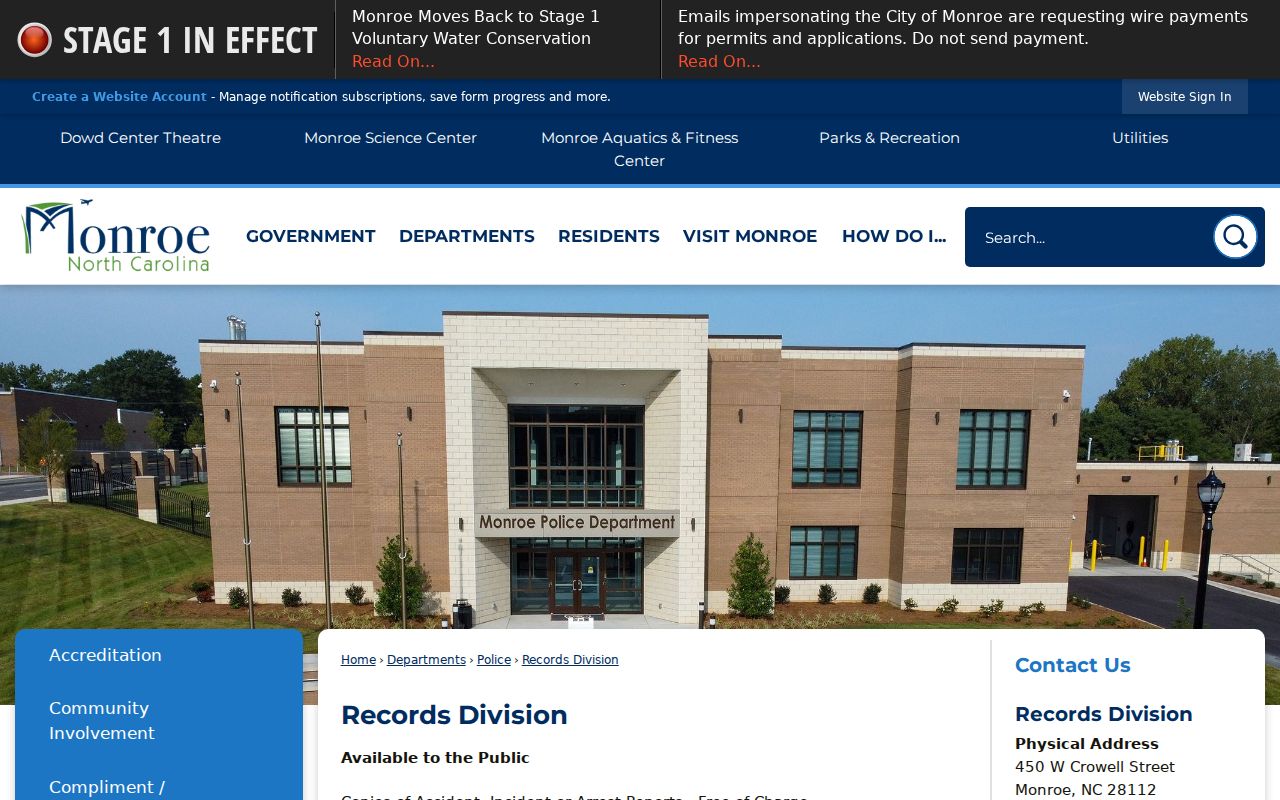
The screen supports a focused Monroe report request rather than a vague inquiry for every record connected to a name. It also documents that Monroe public accident, incident, and arrest report copies are free.
These Monroe police records report allegations and officer activity. They do not prove guilt. If the purpose is to learn the Monroe court outcome, carry the name, date, and any charge detail into the state court search, where the case number and disposition may be found.
Records at the Monroe Police Department
Monroe Police Records operates at 450 W. Crowell Street, Monroe, NC 28112, weekdays from 8 a.m. to 5 p.m. The Monroe Records Division number is 704-282-4728; the department number is 704-282-4700. Existing Monroe accident, incident, and arrest reports may be obtained online, by email, or in person. Monroe expressly says report copies cannot be faxed, even though a fax number appears in department materials.
The official Monroe Police Department page provides the department setting and links its Crime Incident Map.
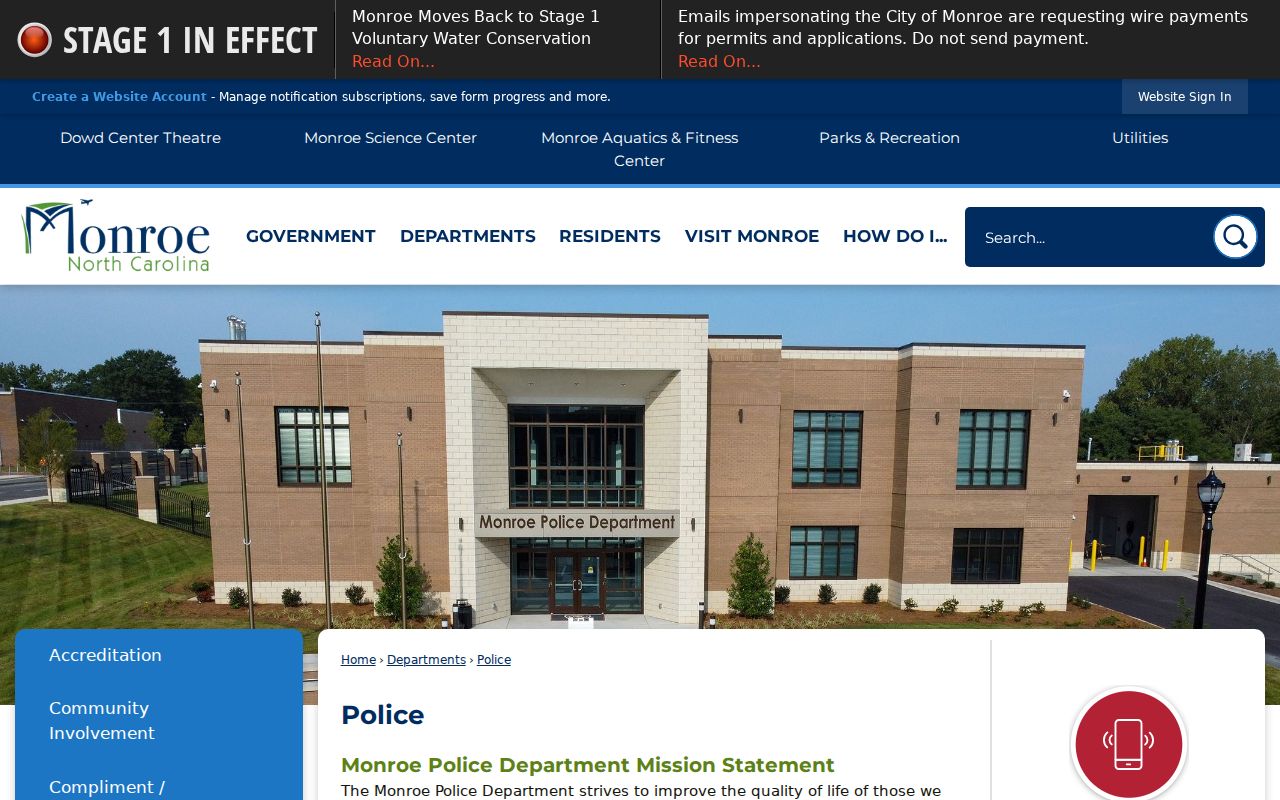
This Monroe department page is the correct starting point for Monroe police services, but the Monroe Records Division page gives the more precise report-copy rules.
Monroe Police Records Division
450 W. Crowell Street
Monroe, NC 28112
704-282-4728
Monday-Friday, 8 a.m.-5 p.m.
Monroe Records: Direct or NextRequest
Use the direct Monroe Records Division route for an already-public accident, incident, or arrest report. Those Monroe copies are free, and staff publish the three search keys they can use. A broad request for other Monroe documents belongs in Monroe's NextRequest system. The city says those public-record requests are handled first come, first served and are typically fulfilled within four weeks.
The Monroe public-record request page explains the general queue and supplies the source view shown here.
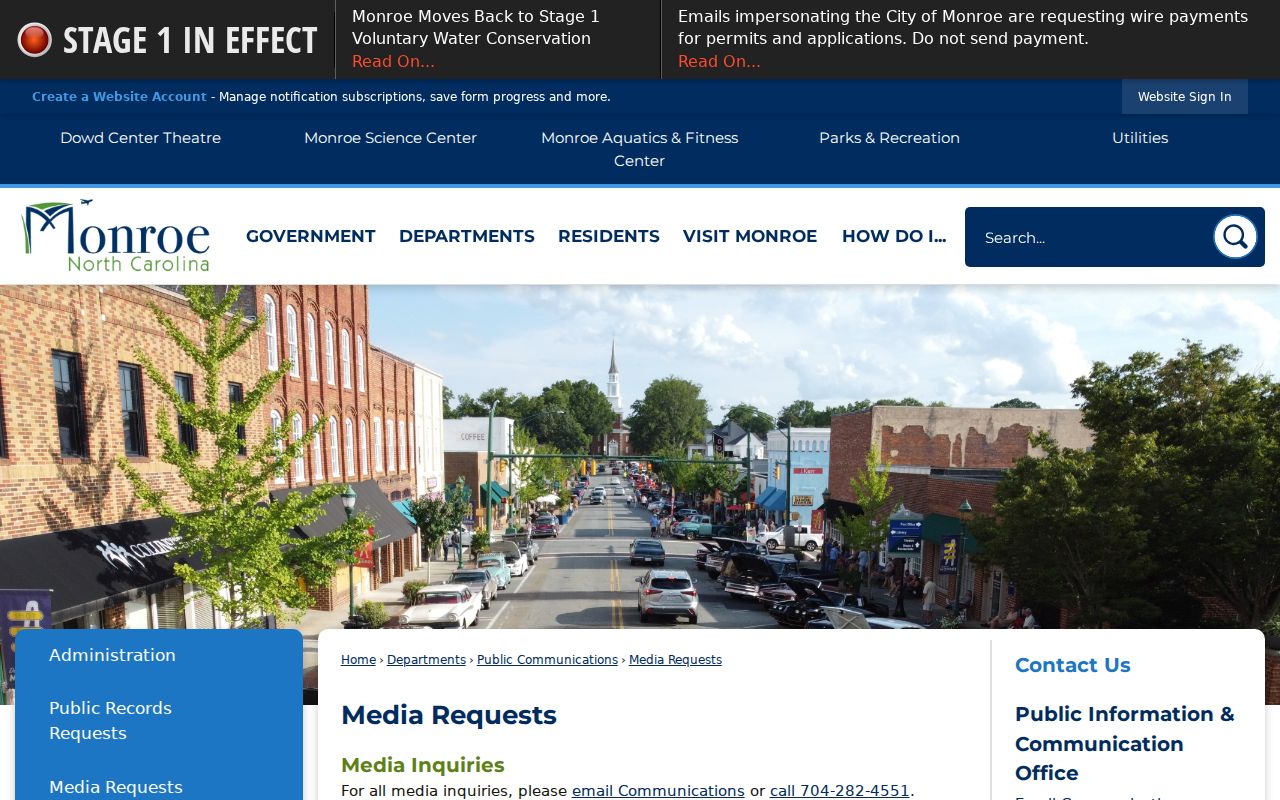
The Monroe distinction matters: placing a routine Monroe police report in a broad city-document queue may add delay when the Monroe Records Division already has a direct channel.
A separate Monroe non-emergency incident-report PDF creates a new police report. It does not retrieve an old Monroe record. The form asks for the reporting person's contact details, incident date and time, offense type, location details, suspect information if known, and a narrative. Its Submit and Print choices are Monroe report-initiation methods, not copy-delivery options.
Booking and Arrest Records in Monroe
A Monroe officer's arrest report remains a Monroe Police record. The city does not advertise a city jail, so custody and booking run through the Union County Sheriff's detention operation. A person held after a Monroe arrest may appear in the county Inmate Inquiry, while the city report remains obtainable through MPD. Released people may no longer appear in a current-custody search.
The Monroe booking entry may show intake time, presented charges, bond, and custody status. That Monroe information can change. Prosecutors decide what to file, and a court may dismiss, amend, or resolve a charge later. The dedicated Union County arrest search explains county booking channels in greater depth.
Do not treat an arrest report or jail entry as a conviction record. For a final outcome, move to the Union County court file and compare identifiers. Recent police data may appear before the court case, and a filed case may use a different number from both the report and the booking.
Note: Release from county custody does not show whether a Monroe charge was dismissed, pending, or resolved.
Monroe Crash Record Checklist
Monroe asks requesters to allow three business days before seeking a Monroe DMV-349 crash report. Bring valid identification and the Monroe report number when possible. The published Monroe eligibility description covers drivers or passengers, vehicle owners, and their representatives in legal or civil proceedings. Online and counter copies are identical.
Before requesting a Monroe crash record, check these items:
- At least three business days have passed.
- The report number is available, if known.
- Valid identification is ready.
- The requester fits the city's stated access categories.
- The incident was handled by Monroe Police rather than another agency.
If another agency investigated the collision, use that agency's channel. A State Highway Patrol crash is not converted into a Monroe record merely because the crash occurred near the city.
The Monroe Municipal Court File
There is no Monroe municipal criminal court. The county-seat location can make the courthouse look like a city institution, but criminal cases belong to North Carolina's unified General Court of Justice. Union County District Court handles misdemeanors and preliminary felony matters. Superior Court hears felony trials. The Clerk of Superior Court maintains both sets of files.
Use these Monroe record facts to avoid requesting a nonexistent Monroe city-court docket:
| Court Name | Union County District Court or Superior Court, not a Monroe municipal court |
|---|---|
| Case Types Heard | District Court handles misdemeanors and early felony proceedings; Superior Court hears felony trials |
| Case Lookup Channel | North Carolina eCourts Portal or the Union County Clerk of Superior Court |
| What the File Shows | Case number, charges, events, hearings, pleas, judgment, sentence, and disposition when public |
| Official Copies | Request from the Clerk; ask about current copy and certification charges |
The public eCourts summary is useful for Monroe cases, but the Judicial Branch says the Portal is not the official court record. The clerk's maintained Monroe file controls when exact language or certification matters.
Monroe Records Across Three Custodians
One Monroe arrest can create at least three records. MPD documents the officer's actions and alleged offense. The Union County Sheriff creates the booking and custody entry. The state court system creates the case file after charges are filed. None of these custodians automatically replaces the others.
| Monroe record | Custodian | Best question |
|---|---|---|
| Incident or arrest report | Monroe Police | What did the responding officer record? |
| Booking or custody entry | Union County Sheriff | Was the person booked or currently held? |
| Criminal case file | Union County Clerk | What charge was filed, and how did court resolve it? |
A Monroe name appearing in only one source is not proof the other records do not exist. Timing, spelling, identifier differences, and restricted data can affect Monroe visibility. Compare the incident date and person details, then ask the originating office to correct its own Monroe record if something is wrong.
How Monroe Records Reach the County
Monroe Police creates the local report. If an arrest leads to custody, the sheriff books the person at the county detention operation. Prosecutors then determine the filed charge, and the Clerk of Superior Court opens and maintains the District or Superior Court case. Fingerprint-supported arrest information may also flow into the SBI computerized criminal history, with associated dispositions when available.
Record flow: Monroe Police Department › Union County Sheriff and Courts › North Carolina State Bureau of Investigation
The newest detail is often held closest to the event. MPD is the direct source for a fresh city report; the sheriff answers present custody; the clerk supplies the court result. For a personal statewide review, SBI requires fingerprints because North Carolina does not offer the general public an unrestricted state name-check portal. Missing Monroe data can reflect reporting lag or a record that belongs to another system. It should not be read as proof that no Monroe event occurred. An arrest cycle without a disposition should be checked against the clerk's Monroe file before conclusions are drawn.
Note: SBI history is fingerprint-supported and does not replace the detailed Monroe police report or court docket.
Monroe Body-Camera Record Limits
Body-worn camera video does not follow the same access path as a basic Monroe incident report. North Carolina treats these recordings outside ordinary Chapter 132 public-record production. A 2021 Monroe case illustrates the difference: a Superior Court judge reviewed the matter and ordered release under the separate statutory process.
A routine NextRequest submission therefore does not promise delivery of Monroe body-camera footage. A requester should identify the recording, relationship to the event, and basis for seeking disclosure, then follow the judicial route that applies. Basic public incident information may still be available even when footage or investigative material is withheld.
This limit also explains why a police record can have public and nonpublic layers. Time, place, accusation, and certain arrest facts may be open while victim details, juvenile information, active investigative material, and recorded video remain restricted or require a court order.
Monroe Crime Map Records vs Outcomes
Monroe's police hub links a Crime Incident Map. Map activity can help place a reported event by location and date, but it is not a conviction list. A pin or incident classification reflects law-enforcement data. It does not show that prosecutors filed the same offense or that a court entered guilt.
The same caution applies to MPD's 2025 Internal Affairs summary, which reports seven complaints involving twelve officers and one civilian, with three complaints originating outside the department. Those are complaint counts, not findings of criminal guilt. Use the source for its stated metric and do not merge it with arrest or case totals.
For a Monroe case outcome, search the court record. For a police narrative, use the report channel. Keeping source and meaning paired prevents an incident map, complaint report, checkpoint release, or booking entry from being overstated.
Note: Monroe map and complaint totals describe agency activity, while court dispositions answer a different legal question.
Monroe Record Access Rules
North Carolina law opens many government records while preserving specific exceptions. Monroe must permit access to public records at reasonable times and provide copies as promptly as possible, but it need not create a new compilation. Criminal investigative and intelligence records are generally outside ordinary public access, even though the statute makes defined basic incident and arrest information public.
Court records follow a separate rule. Clerk-held files are open unless another law restricts them. Juvenile files, expunged records, protected personal identifiers, victim information, and some investigative content can be sealed, redacted, or withheld.
Key Statutes:
G.S. 132-1 broadly defines public records made or received in public business, subject to statutory exceptions.
G.S. 132-1.4 protects investigative records while identifying basic law-enforcement information that remains public.
G.S. 7A-109 governs public inspection and copies of court records kept by clerks.
Ask the actual custodian for the specific Monroe record. If a request is denied or redacted, request the legal basis and determine whether a public basic-information portion can still be released.