
Union County Sex Offender Checks
The North Carolina Sex Offender Registry is the main public channel for a Union County sex offender lookup. The North Carolina State Bureau of Investigation maintains the statewide system, while each county sheriff handles in-person registration and local verification. Searchers can use the name form, a location search, or the map and list views. Selecting Union in the county field keeps common names from producing an unchecked statewide list.
The registry is specialized. It reports people who must register under North Carolina law, not every person with a sex-offense case and not every criminal court outcome. A missing name does not prove that an address presents no risk. Likewise, a matching name should be checked against the photograph, physical description, county, address, and conviction information before any conclusion is drawn.
The official registry landing page is shown here before the map and search modes are selected.
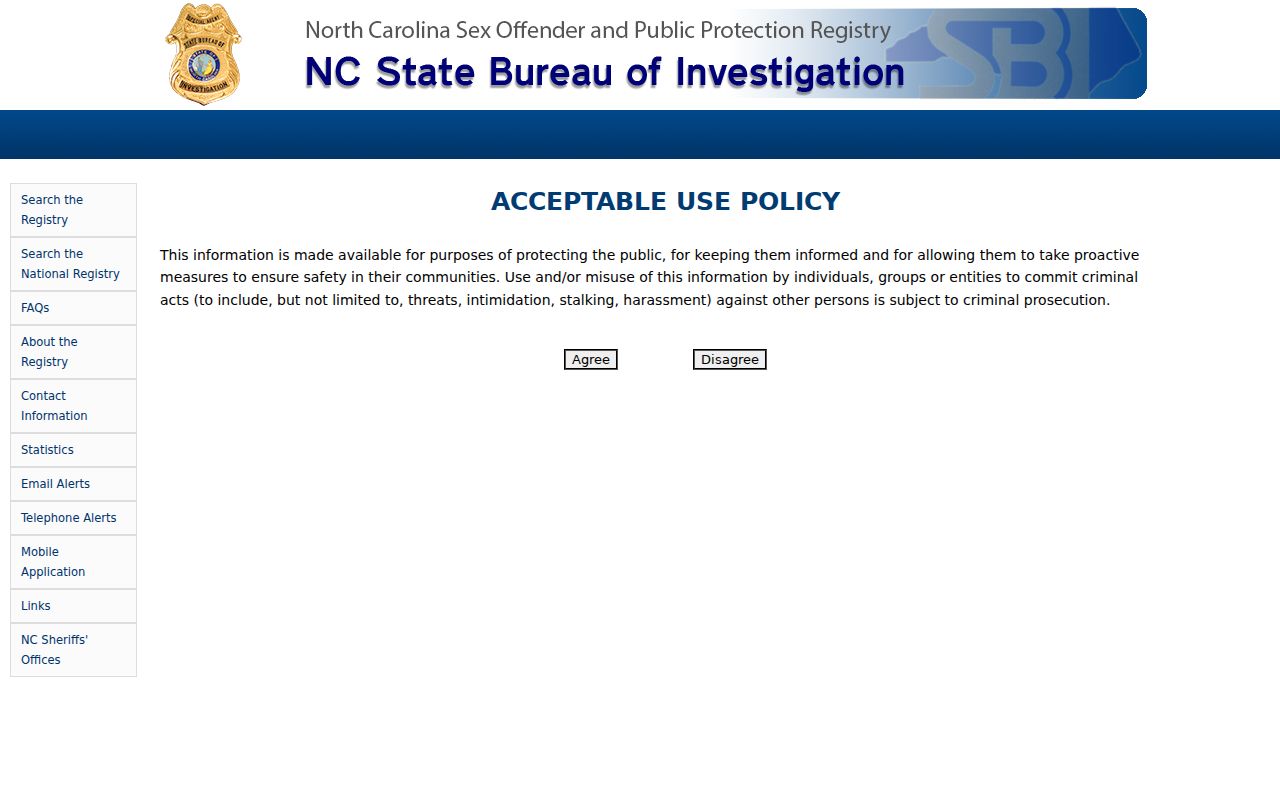
The landing screen helps Union County residents choose between a person search and a place-based registry check without exposing any individual profile.
Union County Registry Office
Registration takes place with the sheriff in the county where the person resides. For Union County, the local authority is the Union County Sheriff’s Office at 3344 Presson Road, Monroe, NC 28112. The main number is 704-283-3789. A registrant should call first to confirm the correct registry-unit entrance, current hours, appointment process, and documents to bring, since those operating details were not published in the researched pages.
Union County Sheriff’s Office
3344 Presson Road
Monroe, NC 28112
704-283-3789
County registration, required updates, verification, and suspected noncompliance routing.
Public users should also call the Sheriff when an address or compliance status appears wrong. Give the registry name or identifier, the address in question, and the specific discrepancy. Do not visit the listed home or confront a registrant. Call 911 only when there is an immediate emergency.
Note: The Presson Road office is the local registration authority, but current intake details should be confirmed by phone before a visit.
North Carolina Sex Offender Registry Searches
The official North Carolina registry search supports both person and location questions. Use the least amount of information needed to get a workable result, then narrow it. Required status is not marked consistently on the public form, so fields described as unspecified should not be treated as mandatory.
- Open the official search and review its conditions of use.
- Enter a name, or choose a location route using Union County, a city, ZIP code, or street address.
- Compare the results by photograph, aliases, physical description, and reported address rather than relying on a name alone.
- Open the public profile and read its registration status, conviction, vehicle, address, and verification details together.
| Field Label | Type | Required | Notes |
|---|---|---|---|
| Last, First, Middle Name | Text | Unspecified | Known spelling helps; first and middle names narrow common surnames. |
| County | Dropdown | No | Select Union for a county-focused result. |
| City or ZIP Code | Text or select | No | Narrows the geographic result set. |
| Street Address | Text | Address mode | Accepts a North Carolina address for proximity searching. |
| Radius | Radio or dropdown | Address mode | One, three, or five miles for proximity alerts. |
| Map or List | View controls | No | Changes result presentation, not registry scope. |
The blank NCSBI search interface appears here with its person and place controls.
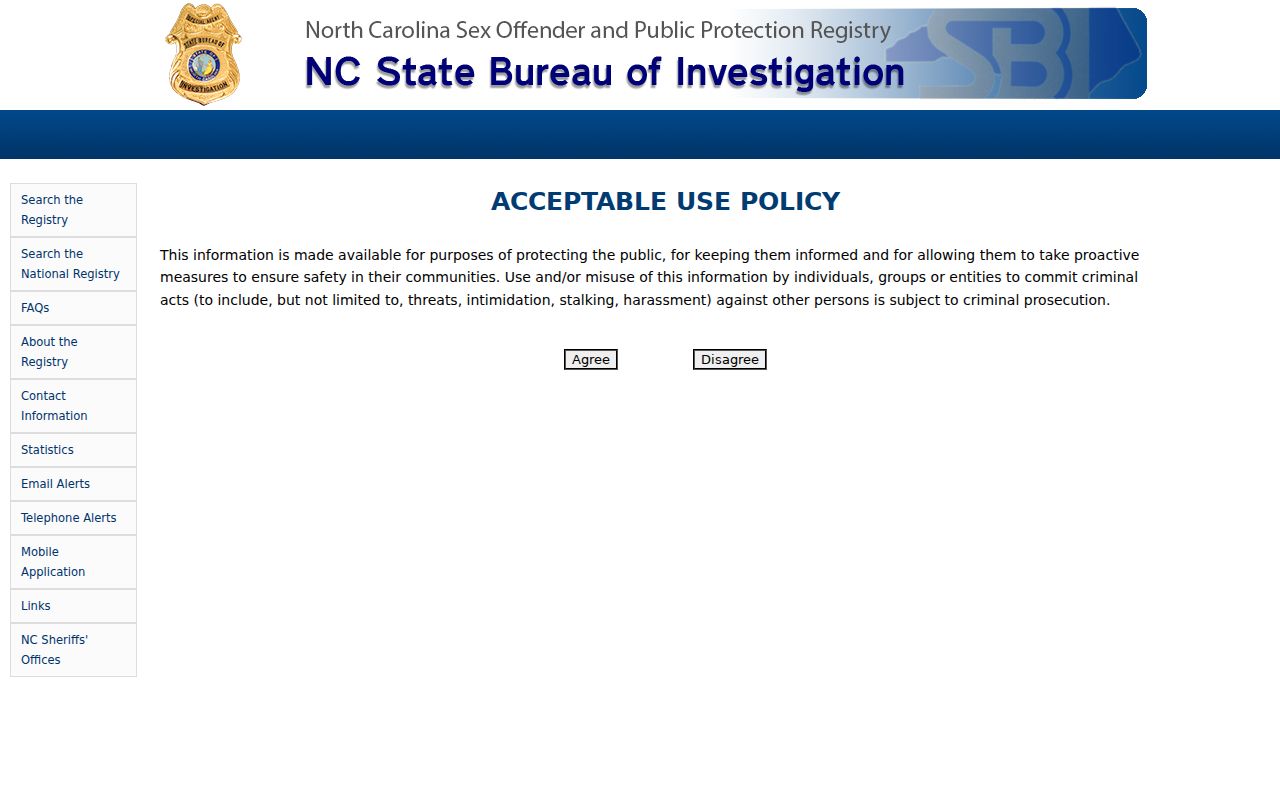
The blank screen keeps the focus on search fields and avoids making a private person’s identifying details the visual subject.
Union County Registry Alerts
The registry FAQ allows an email notification for a reported move to a North Carolina address within one, three, or five miles of a subscriber’s home. This is useful for ongoing neighborhood awareness because it does not require repeating the same address search each week. The radius is a notification filter, not a measured legal boundary and not a forecast of conduct.
Address results also depend on geocoding, which is the process of placing a typed address on a map. Variations in street format, apartment data, new construction, or a recently reported move may affect where a pin appears. Compare the profile’s written address with the map. If the two conflict, report the issue to the Sheriff or SBI instead of treating one view as conclusive.
NCSBI’s official registry statistics interface is pictured here and includes a county filter.
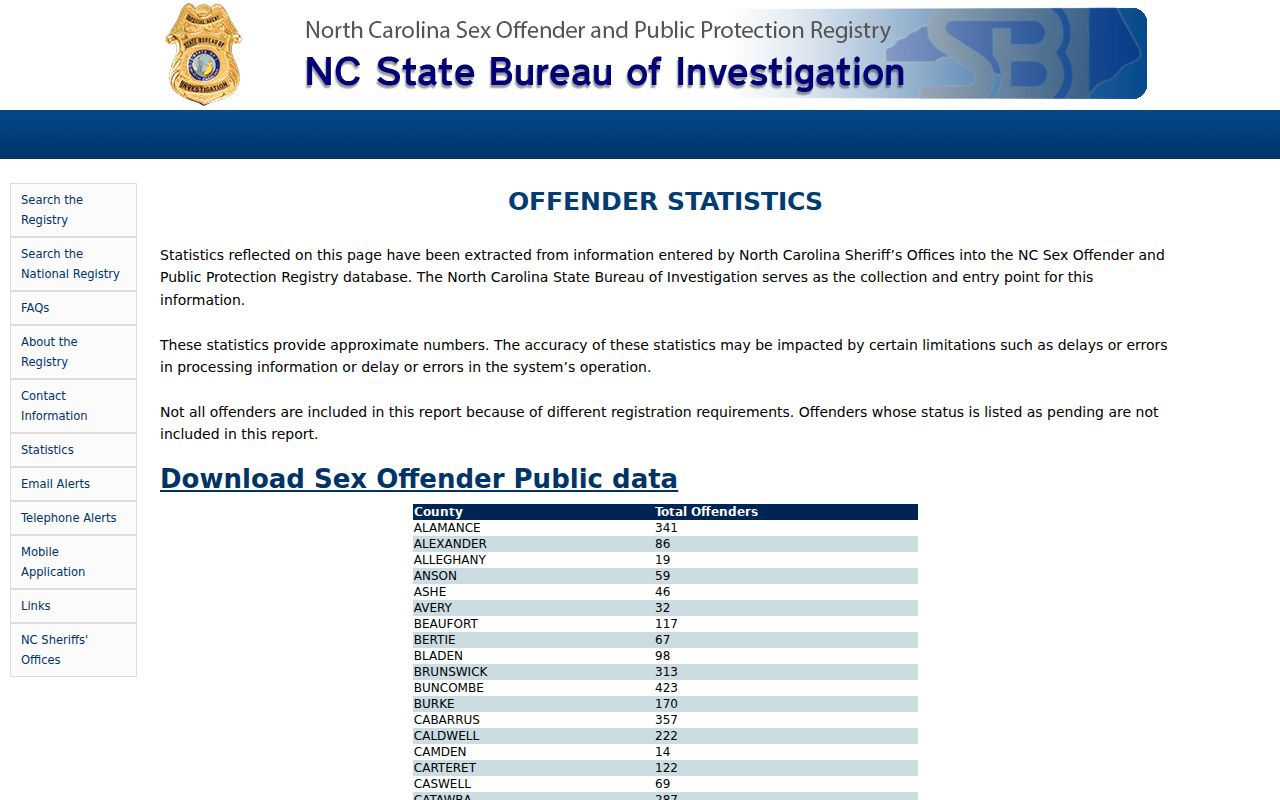
The statistics screen provides aggregate context without replacing a name, address, or profile-level search.
Registry Profiles: What They Show
A public profile brings several kinds of registry data together. Read the whole entry because each field answers a different identification or compliance question. Some data appear only when reported, and the Sheriff and SBI update different parts of the process.
| Name and Aliases | Recorded name plus known aliases used to distinguish similar names. |
|---|---|
| Photo and Description | Photograph, sex, race, height, weight, eye and hair color, age data, and reported scars, marks, or tattoos. |
| Reported Addresses | Primary and secondary or temporary addresses when supplied, along with county information. |
| Offense Details | Reportable conviction description, jurisdiction, conviction date, and statute or charge details. |
| Status and Identifiers | Registration or SBI identifier, registration status, and verification or address information. |
| Vehicle Information | Vehicle details when they have been reported and are public. |
Victim identity is not a public registry field under G.S. 14-208.6A and 14-208.10. Juveniles adjudicated delinquent are not placed on the public registry, even for a sexually violent offense. A juvenile transferred to Superior Court and convicted there of a qualifying offense registers under the adult rule in G.S. 14-208.6B.
Union County Registry Across States
Union County sits near South Carolina, so a place-based inquiry may need more than one state registry. The Dru Sjodin National Sex Offender Public Website, commonly called NSOPW, federates searches from participating jurisdictions. It is the appropriate cross-state layer when a name, former address, or regular travel pattern reaches beyond North Carolina.
NSOPW does not replace the source-state record. Search nationally to find possible jurisdiction matches, then open the linked North Carolina or other state profile for the current fields, legal definitions, and reporting contact. State systems can classify offenses and display data differently. A missing national result can also reflect a jurisdiction’s law, a protected record, or update timing rather than a verified absence.
Registration Levels and Duties in North Carolina
North Carolina does not label public registrants Tier I, II, and III in the federal SORNA style. Its Article 27A uses two main state tracks. A person registers in person with the sheriff of the county of residence and must report required changes within the law’s short deadlines.
| North Carolina Category | Duration | Verification |
|---|---|---|
| Part 2: offense against a minor or sexually violent offense | At least 30 years; a petition may be possible after 10 years if statutory findings are met | Semiannual sheriff process under G.S. 14-208.9A |
| Part 3: recidivist, aggravated offender, or court-classified sexually violent predator | Lifetime, subject only to statutory exceptions | Every 90 days under G.S. 14-208.24 |
A new North Carolina resident must register within three business days of establishing residence or after being present in the state for 15 days, whichever comes first. An existing resident generally registers within three business days after release or arrival in the county, or immediately after conviction when no active prison term is imposed.
Union County Registry Restrictions
Two distance rules often cause confusion. G.S. 14-208.16 restricts covered registrants from residing within 1,000 feet of school or child-care premises, subject to the statute’s definitions and exceptions. G.S. 14-208.18 restricts specified registrants from knowingly being within 300 feet of places intended mainly for minors in stated circumstances.
A public map pin does not decide whether either law applies. The rules turn on the person’s covered status, the type of place, how distance is measured, and statutory exceptions. Registry mapping is therefore a public-awareness aid, not a property survey or legal opinion. A registrant with a compliance question should use the current statute and contact the Union County Sheriff’s registration staff.
Note: A mapped distance can help frame a question, but only the governing facts and current law determine a registration duty.
Correcting Union County Registry Data
When a Union County profile appears to show an old address, a wrong map point, or a questionable compliance flag, save the public URL and note the exact field. Contact the Sheriff with the registry identifier and the discrepancy. SBI’s registry FAQ explains accuracy limits and public notification options. It also makes clear that sheriffs and SBI work to keep records current.
Do not attempt to verify an address in person. A status concern may involve reporting time, data entry, geocoding, or an active inquiry that is not explained on the public screen. Law enforcement can compare the report with nonpublic records and decide what follow-up is proper. VINELink can provide telephone notice of a registrant’s custody status change, but it does not correct the registry or replace the Sheriff.
Using Registry Information Lawfully
North Carolina publishes registry information for protection and community notice. Appropriate uses include checking a name, learning about reported moves near a North Carolina address, and planning family or neighborhood safety. A registry entry does not authorize public punishment, surveillance, threats, or direct confrontation. Suspected violations belong with law enforcement.
Use the record safely: Misusing registry information to threaten, intimidate, or harass a registrant or household member can be a crime under North Carolina law. The registry operates under Article 27A. Report an urgent threat to 911 and suspected noncompliance to the Union County Sheriff.
The warning applies even when the profile is accurate. Registration is a legal status with set duties, not permission for vigilantism. Readers should keep the specialized scope in mind as well: the registry is not a complete Union County criminal record, and it does not predict whether someone will commit an offense.